Claim, Evidence, Inference: Three Parts of a Persuasive Message
Claim, evidence, and inference help you separate what a message says from what supports it and how the reasoning connects the two.
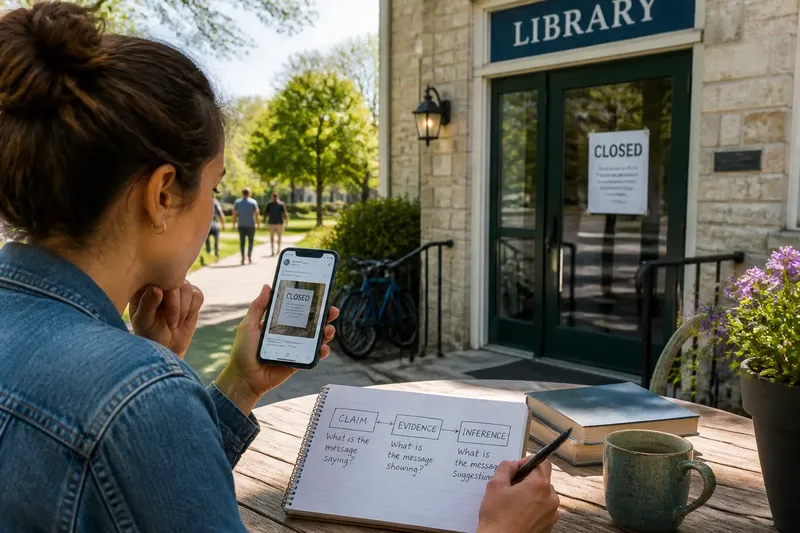
A group chat message says the neighborhood library is about to close, then points to a photo of a paper sign on its door. Claim, evidence, and inference are three different parts of that persuasive message: what it asserts, what it offers in support, and the reasoning that links them. Separating those parts helps you judge what the sign actually establishes before you pass along the alarm.
1. Find the claim the message wants you to accept
A claim is a statement that can be assessed as true, false, incomplete, or uncertain. In the library message, “The library is about to close” is the central claim. The words around it may add urgency or blame, but the claim is the point the sender wants the reader to believe.
Some messages carry several claims at once. “The library is closing next week because officials ignored residents” asserts both a closure and a cause. Treat those as separate statements: evidence that a closure is planned would not, by itself, establish why officials made the decision.
To isolate a claim, ask what a reasonable reader would repeat after seeing the message. If the answer is broad or vague, make the statement more precise. “The library will close next week” can be checked more directly than “The library is under attack.”
2. Identify the evidence offered for that claim
Evidence is the material presented in support: a document, photograph, recording, observation, or cited statement. It is not automatically reliable just because it looks official or appears beside a confident claim. The relevant question is what the material shows, and whether it bears on the exact statement at issue.
In the library scenario, the sign is evidence that a notice was posted. Its wording might announce a temporary closure for repairs, a change in hours, or a permanent shutdown. A photo of the sign alone may not establish which interpretation is correct, particularly if part of the text is out of view.
Read or inspect the evidence itself when possible, rather than relying only on a caption. Look for details that affect meaning: the document’s date, the full sentence, the scope of a quoted passage, or whether a chart’s labels match the claim. If the message offers no supporting material, that absence is useful to notice; it does not, by itself, prove the claim false.
3. Spell out the inference connecting the two
An inference is the reasoning that moves from evidence to claim. It often stays unstated, which lets a conclusion sound more direct than it is. A reader may see a closure notice and infer that the library is shutting down permanently, though the sign might describe a short interruption.
Try putting the hidden connection into a sentence: “Because this sign announces a closure, the library will close permanently.” Now the leap is visible. The evidence may support a narrower conclusion—some closure is planned—without supporting the permanent-shutdown claim.
This distinction is like sorting a grocery receipt, the groceries in a bag, and the guess that dinner is already cooked. The receipt records a purchase; the bag contains ingredients; the conclusion depends on an extra assumption about what someone did with them. In a persuasive message, that assumption is the inference, not another piece of evidence.
4. Check whether the evidence matches the claim’s scope
Claims can be broader than their support. One photograph of a crowded bus may show that one bus was crowded at one moment; it cannot establish that every bus on the route is crowded all day. Watch for changes in scope, such as one person becoming “everyone,” one location becoming “the whole city,” or a temporary event becoming a permanent trend.
Words that signal broad reach deserve a closer look: “all,” “never,” “proves,” and “caused.” Ask whether the evidence covers the same people, place, period, and outcome named in the claim. If it covers only part of that territory, narrow the conclusion to fit.
Say you receive a neighborhood post claiming that a new traffic sign has made the intersection safer, supported by a photo of a car stopping at the line. The photo shows one driver stopping; it does not establish a general safety change. A more careful reading would say the image illustrates a stop, while the broader claim needs evidence suited to the broader question.
5. Notice when a conclusion depends on missing alternatives
Evidence can fit a claim without uniquely supporting it. A shop’s lights being off could be consistent with a permanent closure, but also with a holiday, a power interruption, or a delayed opening. An inference becomes stronger when it considers plausible explanations that fit the same observation.
Ask, “What else could produce this evidence?” This is not a demand to invent far-fetched possibilities. It is a way to notice ordinary alternatives that the message may have skipped. A single observation often supports several explanations, so the claim should not outrun what distinguishes them.
6. Keep the three parts separate when the message is emotional
Urgent language can make a claim feel settled before its support has been examined. “They are hiding the truth about the library” may stir suspicion, but it does not specify what is being hidden, what evidence supports that allegation, or how the evidence leads to it. Translate the message into plain statements before judging it.
A compact note can help: claim, evidence, inference, and what remains uncertain. This is not a verdict machine; it is a way to keep a vivid caption from merging with a photograph or document. You can accept the evidence, question the inference, and leave the larger claim unresolved at the same time.
Questions readers ask about claims and evidence?
Can a claim also serve as evidence?
A statement can be evidence for a different claim, depending on who made it and what question is being considered. But repeating the original claim is not independent support for that same claim; the reasoning still needs a basis beyond its own wording.
Does one piece of evidence prove a claim?
Sometimes a direct, well-matched record can support a narrow claim strongly, while a broad or causal claim usually needs more than one kind of support. Ask what the evidence actually covers rather than counting items or treating “proof” as a label supplied by the message.
What should I do when the inference is unstated?
Write the connection in your own words, starting with “This supports the claim because…” If the sentence relies on an assumption, name it and consider whether the evidence gives you a reason to accept it.
Can I share a claim that remains uncertain?
You can describe what is known without presenting the disputed conclusion as settled. For example, say that a sign announces a closure, then add that its duration or purpose is unclear if the sign does not answer those questions.
Leave room between what is shown and what is concluded
When a persuasive message arrives, separate its claim, evidence, and inference before deciding what to believe or repeat. That small pause makes the claim, evidence, and inference in a message easier to assess on their own terms. It also lets you share useful evidence without quietly adding a conclusion the evidence cannot carry.